Showing posts with label fact fluency. Show all posts

Friday, August 1, 2014

Summer Gems


Here are two articles you shouldn’t miss this summer, and they make a nice pair.

Why Do Americans Stink at Math?” by Elizabeth Green, July 23, New York Times, and “Most Math Problems Do Not Have a Unique Right Answer” by Keith Devlin, August 1, 2014, Devlin’s Angle.

I’ve come to the conclusion that our old ideas and stereotypes about math and education are hard to shake. It really means reading articles like these as they come out every month or so, in order to truly change our minds and our practice.

To whet your appetite, here are a few quotes:

One of the first math classes he observed gave him such a jolt that he assumed there must have been some kind of mistake. The class looked exactly like his own memories of school. “I thought, Well, that’s only this class,” Takahashi said. But the next class looked like the first, and so did the next and the one after that. The Americans might have invented the world’s best methods for teaching math to children, but it was difficult to find anyone actually using them. - from “Why Do Americans Stink at Math?”

Having earned my living as a mathematician for over 40 years, I can assure you that the belief is false. In addition to my university research, I have done mathematical work for the U. S. Intelligence Community, the U.S. Army, private defense contractors, and a number of for-profit companies. In not one of those projects was I paid to find "the right answer." No one thought for one moment that there could be such a thing. - from “Most Math Problems Do Not Have a Unique Right Answer”

The last summer gem is this youcubed video about using Number Talks in math class. How would you solve 18 x 5 mentally?

Tuesday, October 30, 2012

Fact Fluency


What is it about fact fluency that is so challenging for some students? It’s not uncommon for students to lack automaticity with their addition, subtraction, multiplication, and division facts into middle school and beyond. Struggles with fact fluency sometimes accompany low achievement in math, but that is not always the case. Sometimes struggling math students know their facts. Sometimes high-achieving students do not know their facts.

I am reading John Tapper’s excellent new book entitled Solving for Why: Understanding, Assessing, and Teaching Students Who Struggle with Math.  Tapper devotes a section of the book to students who face challenges in short term, long term and working memory. He weighs in on the fact fluency question there.

What students need to understand are underlying mathematics concepts. Multiplicative and proportional reasoning are, for example, critical to moving on from elementary mathematics. Fact retrieval certainly facilitates learning in these areas, but the inability to retrieve facts will not prevent students from reasoning at higher levels. Knowing math facts is important, but fact retrieval is to mathematics what spelling is to literacy: we want students to be proficient at the skill, but the skill is a small part of the overall picture. If a student is able to spell but cannot write a coherent essay, the spelling does them little good. The same is true with math facts. (p. 138)

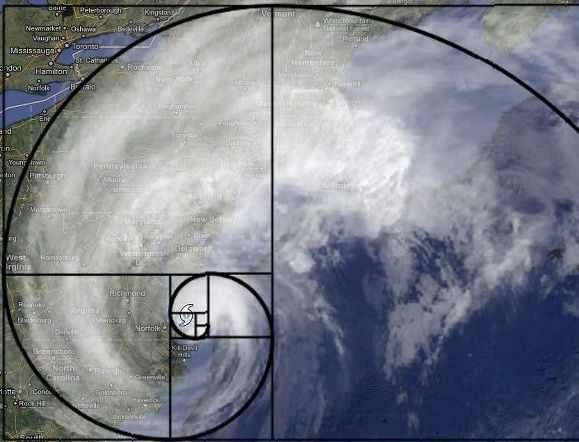
This is interesting for students, parents, and teachers to ponder. Try spending ten minutes a day or less studying math facts. Learn them in a way that reinforces conceptual understanding and is fun. Enjoy higher level, rich mathematics. Like the Fibonacci spiraling Hurricane Sandy picture above.