Tuesday, June 30, 2015
Gay Head Lighthouse
The Gay Head Lighthouse on Martha's Vineyard was moved 135 feet from the edge of an eroding cliff. the move began on May 28, 2015. The 400 ton, 52 foot tall lighthouse was lifted and moved along rails. It took 10 to 15 minutes to move the lighthouse 5 feet. Then the hydraulic jacks were reset and the lighthouse was moved again. How long did it take to move the lighthouse? The total project cost close to $3.5 million. What would you estimate the cost per foot to move the lighthouse? Per inch? What did it cost per pound?
Gay Head Lighthouse Relocation
Tuesday, May 5, 2015
On Productive Failure
Here is a 7 minute video of a young math major, Elly Schofield. She reflects on her K-12 mathematics education, and the disconnect between that and the mathematics she encountered in college.
Tuesday, April 14, 2015
NCSM Boston, 2015. Monday

A room full of math coaches!
NCSM Boston. Some of my Monday notes.
Jo Boaler’s Keynote
On teacher attitudes
We urgently need to shift teachers, parents, and students ideas about who can achieve in mathematics.
Students of color and girls show the sharpest increase in achievement with mindset interventions.
On achievement
The lowest achievers in the world are the "memorizers".
The highest achievers in the world are those who think about big ideas and connections.
On mistakes
Every time you make a mistake in math a synapse fires. When you get a question correct, there is no brain growth.
Teachers should encourage mistakes.
Students need open and challenging work so they will make mistakes.
Teachers need to change classroom culture to openly value mistakes.
Jo has a new version of her book, called What’s Math Got To Do With It
Jo is working on a Week of Inspirational Math, a series of free lessons designed to be used for the first week of school.
Susan Jo Russell
How "Lingering" on Ideas about the Meaning of the Operations Can Include All Students in Significant Learning
Access and equity
Engaging students with challenging tasks, discourse, and open-ended problem solving has the potential to raise the mathematics achievement of all students, including poor and low income students.
"Productive lingering" is essential to engaging in mathematical argument for all.
Amy Lucenta, Grace Kelemanik, Susan Creighton
Engaging ALL Learners in Mathematical Practices through Instructional Routines
All students must be able to…
Interpret and chunk complicated objects,
connect representations
change the form of the numbers, expressions, space, etc. to create and leverage equivalences,
recall and use properties, rules of operations and geometric relationships,
and find the right distance from a problem...i.e. shift perspective.
The math practices open doors for struggling students.
Problems were presented and the audience was asked what we noticed. We were encouraged to find “shortcuts”. However, the shortcuts are based on mathematical reasoning, and are one way to facilitate productive math classes.
If we don't seal the deal with a meta-reflection, we are just talking about strategies.
Students generate “Ask Myself” questions.
Next time I will ....before I calculate because....
Paying attention to ....is helpful because....
Deborah Ball, et al
How can explicitness about mathematical practices support equitable instruction?
Deborah Ball teaching video
Task: Make as many 3 digit numbers as possible using the digits 4, 5, and 6.
I would like someone to give a wrong answer to this problem.
Do others agree this is wrong?
Can someone share one reason why it is not one of the answers?
Explicit teaching…
… unpacks practices or knowledge to make it open to learners, not doing it for them.
...is not about the teacher demonstrating.
...seeks to maintain complexity but make complex practice accessible to all students.
Students do the work, teacher highlights what they just did. Makes elements visible, provides language and supports.
I have opinions about the idea that “mathematicians are lazy” and the term “shortcuts”. I won’t share those now, nor will I write about more speakers I saw on Monday, or all the other questions and thoughts I have, because I am tired and have to get to sleep. Another time.
Labels:
equity,
ideas,
inspiration,
NCSM,
problem-solving
Tuesday, April 7, 2015
Student Self-Assessment
I want to send a huge shout out to Bill Ferriter, here in Burlington from Raleigh, North Carolina. Bill is a sixth grade science teacher with a year-round school schedule that allows him to visit us during our academic year. He is helping Burlington educators improve our collaborative process and our work with students.
One of my big takeaways from spending time with Bill is the importance of student self-assessment. Teaching teams in Burlington have begun creating unit overviews which are given to students so they can chart their learning. Unit overviews vary depending on the teachers and grade level, but most have a way for students to indicate what they know and can do relative to important learning targets. Older students might make a mark on a line somewhere between “Not Yet” and “Got It”, while younger students color in a box or a smiley face next to a skill they have mastered. More important than the format is the fact that students work on their awareness of their own learning. They begin to take responsibility for assessing themselves, rather than leaving that up to parents and teachers.
Researchers and thought leaders in education from Marzano to Wiggins to Hattie agree -- students who are aware of their learning objectives and who are responsible for assessing, charting and sharing their own progress are more likely to be successful. Yet, according to Bill and others, students are rarely asked to assess themselves.
I have been studying the Common Core Standards for years, especially in math at the elementary level, and I think they are mostly wonderful. The content standards emphasize conceptual understanding and depth over breadth. The practice standards focus on critical skills like problem-solving, constructing viable arguments, and critiquing the reasoning of others. An activity like problem-solving requires a good deal of self-awareness and the ability to “...monitor and evaluate their progress and change course if necessary” (a direct quote from the CCSSM). So, in order to master the standards, students would need to have a measure of meta-cognition. However, student self-assessment is not an explicit part of the standards, nor is it an obvious feature in a Common Core program like Eureka Math (EngageNY).
So, how do we ensure students are responsible for self-assessment if it doesn't appear in the standards and programs? Using unit overviews is one way. When a PLC team creates a unit overview, they have the opportunity to collaboratively determine the most important learning targets for their students. In doing so, they have also created a product that students can use to know their goals and take charge of their learning.
Wednesday, February 11, 2015
Geodesic Dome Building, Part II
The dome actually worked! All three fourth grade classes rolled, measured, cut, marked, counted, and assembled two geodesic domes at the Integrated Arts Academy. A quality assurance team was established in order to ensure the newspaper rolls were strong and tight. Partner work was important, so students had one person tape while another person held newspaper rolls in place. Math was happening all around. The domes initially worked great, but then started to droop and fall after a few days. Students fixed them up and brainstormed ways to make them stronger.
This project was shared during an all-school assembly. Three of the fourth graders presented the work with a slideshow created by their class. More fourth graders sat inside one of the domes (to everyone’s delight!) in order to hold it up if it started to droop during the presentation. It didn’t need any support but it was really fun to have them sitting in there. The presentation touched on the math, art, and engineering in this project. Students also explained Buckminster Fuller's humanitarian vision for the geodesic dome.
I loved collaborating with Ada Leaphart, Judy Klima, and the fourth graders at IAA. I hope to do it again soon. There are so many wonderful opportunities to connect math and art in meaningful ways.
Labels:
art,
design,
education,
geometry,
history,
inspiration,
math,
STEM,
triangles,
visual thinking
Sunday, February 8, 2015
From Lani Guinier
I am reading the New York Times on a Sunday, sitting next to the woodstove to keep warm. In an interview entitled Redefining Diversity, Re-evaluating Merit, by Tamar Lewin, Lani Guinier has some important things to say.
The score on your SATs or other exams is a better predictor of your parents’ income and the car they drive than of your performance in college. The credentials of our testocracy legitimize a new elite, and give them an inflated sense of their worth.
Diversity is not simply a matter of having people who look different sitting next to each other but learning in the same way.
Studies show that groups made up of the highest-performing individuals are not as good at solving complex multidimensional problems - like designing environmental policies, cracking codes or creating social welfare systems - as groups with a mix of skills, backgrounds and ways of thinking, even if the individuals in the group are not all high performers.
Guinier’s new book is called The Tyrrany of Meritocracy: Democratizing Higher Education in America.
Labels:
assessment,
equity,
history,
ideas,
inspiration,
merit,
teaching
Monday, February 2, 2015
How to relate, by Alan Alda
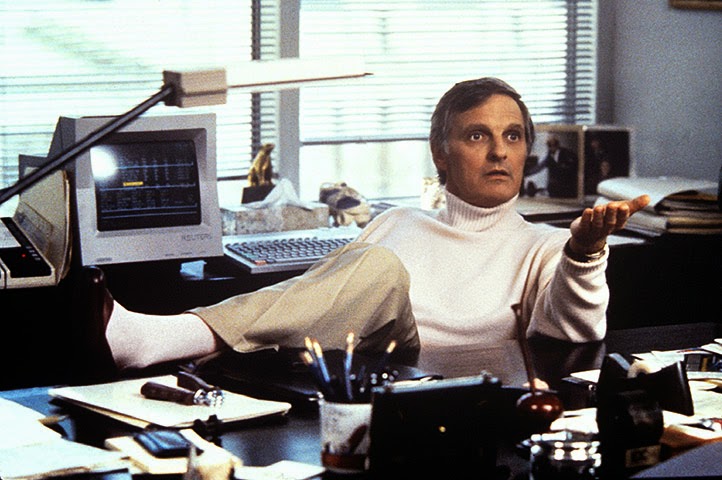
I am watching reruns of M*A*S*H right now as I reflect on seeing the one and only Alan Alda in person at UVM’s Davis Center. I love watching M*A*S*H, as I feel it has held up really well over time and is a perfect mix of funny and tragic. The character Hawkeye Pierce, played by Alda, stands out even though the other cast members are excellent.
Alan Alda was also brilliant in Woody Allen movies, like Crimes and Misdemeanors (“If it bends, it’s funny. If it breaks, it’s not funny.”) Then I began seeing him getting involved in science with Scientific American and other shows that ran on PBS channels. Although today was a snow day and the roads were pretty bad, I and the intrepid Nina Madore weren’t going to miss the opportunity to see him live at UVM. I figured nobody would be there, but the giant Silver Maple Ballroom was packed.

I expected Alan to talk about specific science concepts, but, instead, he talked about being an effective communicator. He got rid of the podium used by those who introduced him in order to be more accessible to the audience. Actively demonstrating the theme of his talk, Alan looked carefully out at the faces in the audience and spoke in a warm, conversational manner without reading any notes. He shared the alarming statistic that 95% of Americans are not considered “science literate”. Then he went on to make the case for scientists learning to be better at relating to laypeople and working to make their research accessible.
Alan shared several ideas that scientists can use to think about improving communication. He talked about using emotion to help lodge ideas in the minds of the audience and using suspense and drama as a hook. At one point, a courageous audience member took the stage to demonstrate by walking across the stage with a very full glass of water. Another audience member was enlisted to demonstrate “the curse of knowledge” by tapping out a song. The curse of knowledge is what happens when you know something so well that you forget what it is like not to know it. In order to be a good communicator/teacher, one must break the curse and use empathy to understand the audience.
Alan’s talk was excellent. I wish more colleagues had been able to attend and that we could participate in some of the workshops he was going to be leading at UVM. His foundation, The Alan Alda Center for Communicating Science has a website worth visiting. UVM is going to begin a similar program and partner with him and his colleagues. In the meantime, elementary and middle school teachers should take a look at The Flame Challenge. Teachers of fifth and sixth graders can register here to let their students be the judges of a contest to see which scientist can best explain the answer to a science question. This year’s question is “What is sleep?”.
Alan has important messages for teachers and scientists and really anyone with a heartbeat. It’s worth visiting his website, reading more, and watching videos. Alan, thank you for coming to Vermont. I look forward to seeing UVM’s efforts in this area.
Friday, January 30, 2015
Educon 2015
I can see why many Educon attendees remarked that they’d spent their own money to be there. The conference, held at Science Leadership Academy in Philadelphia is that good. It was an eclectic group of out-of-the-box thinkers, innovators, and activists. I knew I wanted to go when I saw Chris Lehmann, founding principal of the SLA, speak in Killington last year.
I was a first-timer. Day one was spent at the school - a public high school that is an inquiry-driven, project school - in partnership with the Franklin Institute. I and a few of my colleagues found a student to guide us. She patiently walked us to different classes where we watched, listened, and sat with students to chat. Students in one class passionately explained a project in which they protested the closing of a huge number of Philadelphia public schools. Students in Doug Herman’s photography class told me what they’d learned about composition and layering and why they were in the photography room even though it was actually their lunchtime. In Algebra II they had designed a catapult to hit a target and were typing a reflection about their group process. I was hooked.
Then, of course, there were many great workshops, Ignite talks, and side conversations on Saturday and Sunday. Here are some of the people I met and learned from, along with some quotes and resources.

A highlight of the conference for me and many others, I’m sure, was Raghava KK, the effervescent, charming presenter and self-proclaimed TED whore. Here’s a 4 minute TED on bias and perspectives in history. He helped me remember what it means to be truly creative. You don’t matter, he said to all the educators in the room. Art should be the medium by which stem is taught... Art is how you teach everything... Incorporate visual literacy in everything you do.
Every disagreement is a chance to learn about a different perspective.
Raghava’s co-presenter, Meenoo Rami, an SLA teacher, hosted this session in her classroom. After meeting her, I was sorry I hadn’t made it to her class on Friday.
Diana Laufenberg, of SLA, led a workshop on school transformation and Joni and I sat with a Eric Dale from the Dwight School in NYC and Andrew Gallagher of the NYC Department of Education. We enjoyed hearing about Eric and Andrew's work, marveling over the vastness of the NYC school system. Diana recommended the book Immunity to Change.
Deterritorialize departments. Get away from content and move to skills.

The one thing I wish I'd known about was this idea of transformational resistance.
Is the student trying to transform the environment in some way instead of doing something wrong?
Math and Social Justice, was a session I didn’t attend, but wanted to. Thank you for posting these resources.
Burlington High School (Massachusetts) has a course called Help Desk. See their great website here, which was presented by female STEM enthusiasts on their way to becoming engineers.
There was a really cool panel I was late for. I liked the conversation that was happening when I arrived, which included comments from Otis Hackney, Principal of South Philadelphia High School.
When people say ‘they don't have the background knowledge’, I say, it is your job to give them the background knowledge they need! If they walked in already knowing everything, they don't need us. As an educator you have a job to do.
What if you had a school with mostly white students and all black teachers, what would that be like?

David Jakes, Imagining Digital Spaces for Learning. In groups, we designed a digital learning space, but we were not allowed to discuss any specific tools. Anyone who is working in or redesigning a school should read Toolkit for Designing a Digital Atelier.
Have you intentionally designed a space that intentionally supports your vision of learning?
How do you design a physical space for an increasingly virtual education?

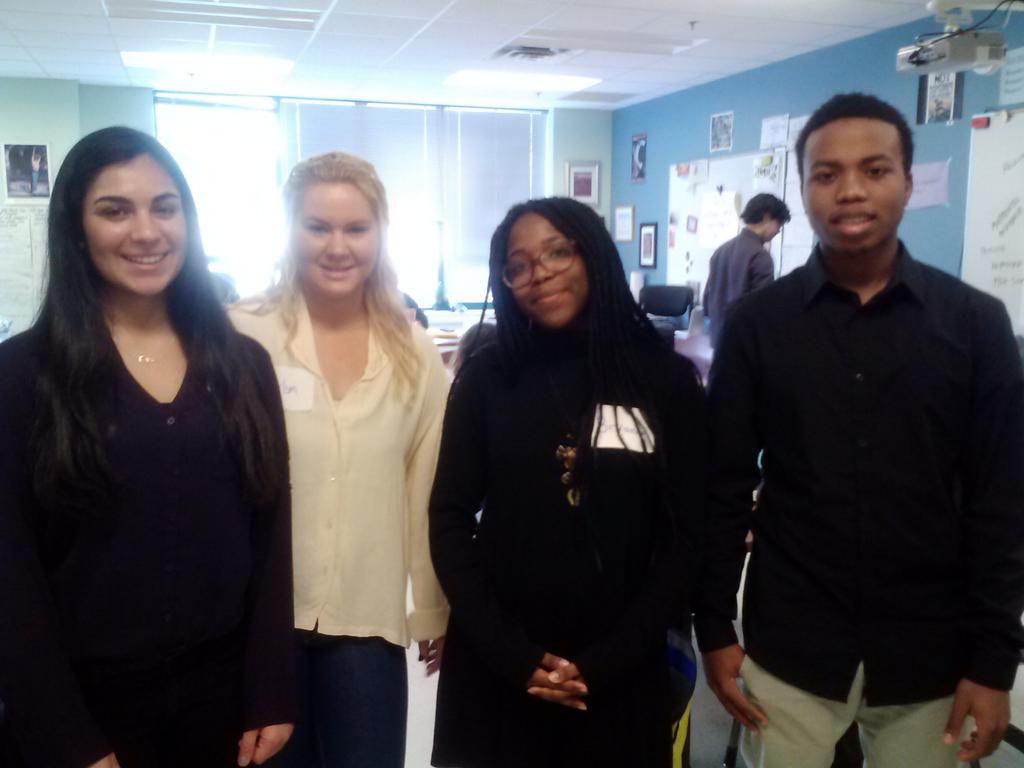
Last but not least, I was in a wonderful session called Shifting the Focus: Elevating Student Voices led by students and their teachers, Josh Block and Amal Giknis. First, the students shared their projects and then we were asked to create an “education manifesto” in 30 minutes that could be posted to twitter with hashtag #focusonvoice. The students were so open and passionate in their presentations and then were so effective as they came around to help us with our assignment...this session is one that has really stuck with me. I was fortunate enough to sit with Renee Hawkins, a very thoughtful educator from a school in Baltimore.
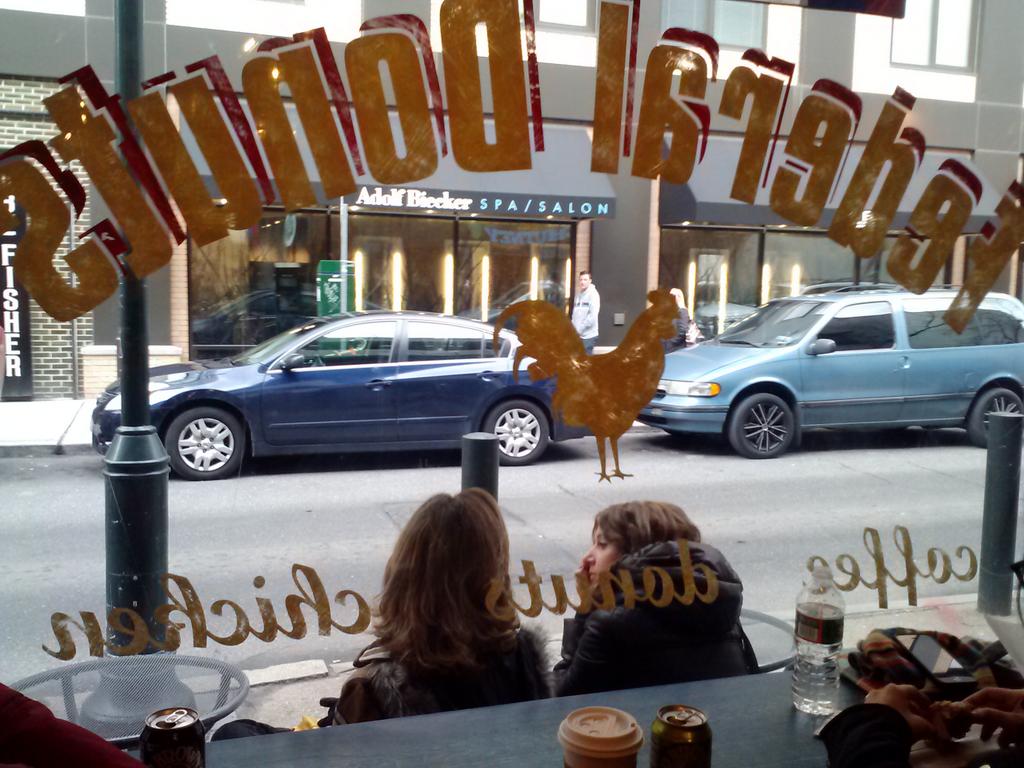
I don’t know how I’ll stay away from Educon next year. I had my mind blown by great thinkers, got to spend time with beloved colleagues, and had my first taste of a grapefruit brulee doughnut from Federal Donuts. As Raghava said, Don’t mess with passion.

Subscribe to:
Posts (Atom)